Copyright Defense Made Simple with AI Technology
The message arrives like a digital punch to the gut. An email appears with a subject line that makes your stomach turn: "LEGAL NOTICE: Demand for Payment" or "LEGAL: Immediate Cessation Required." Your focus instantly changes from revenue forecasts and business development to one terrifying number. A request for payment of $50,000, $100,000, or greater sums for a claimed intellectual property infringement or an old, forgotten debt. Your first impulse is to contact an attorney, but this instinct is followed by a fresh surge of worry when you discover the retainer fee: $10,000, $15,000, or as much as $25,000 to start. For many small business owners, this presents an impossible decision-an option between a devastating financial agreement and an economically devastating court fight.
But imagine there's a different approach? What if you could respond strategically without breaking the bank? For a growing number of entrepreneurs, this solution is becoming available through AI legal defense. This doesn't mean eliminating attorneys completely, but about transforming how legal matters are handled. It's about using powerful technology to evaluate challenges, create defenses, and comprehend your legal standing before paying for traditional legal counsel. This is the story of how small business owners are turning the tables on legal bullies, reducing massive legal expenses, and discovering the strength to stand up for their companies in a world where legal threats are becoming increasingly common.
Critical Insights
- The Power Dynamic is Shifting: AI tools are making it possible company leaders to manage common legal issues on their own, minimizing dependency on high-priced lawyers for preliminary legal responses.
- Knowledge is Your Strongest Protection: The majority of legal challenges small businesses face are intimidation tactics based on flimsy legal grounds. Familiarity with copyright law basics and debt validation requirements becomes your most effective protection.
- AI as a Research Assistant: AI systems can analyze legal documents, pinpoint issues in claims, and find applicable legal precedents in significantly less time than manual research, cutting down on expensive billable hours.
- Financial Considerations are Key: Traditional legal retainers beginning at $10,000-$25,000, artificial intelligence-based solutions offer an affordable initial legal safeguard at a significantly lower price point.
- Recognizing When to Consult a Professional: Artificial intelligence is a helpful aid in preparation and early action, but it is not meant to be a substitute for a professional legal expert in cases involving legal proceedings or intricate legal issues.
Essential Legal Considerations for Small Business Operations
Being a small business owner means wearing multiple hats. You're simultaneously the CEO, marketing director, HR manager, and often the cleaning staff. The last thing you can afford is legal trouble in your business journey. However, contemporary business operations face numerous legal challenges. Research from 2023 reveals that small businesses in the United States lose $160 billion yearly due to lawsuits. These aren't just major lawsuits making headlines; they're the everyday legal challenges that steadily consume business funds.
The Emergence of the Legal Bully
Many legal threats aren't focused on justice; they are simply a numbers game. Aggressive collectors, predatory firms, and copyright trolls distribute thousands of demand letters, knowing that a portion of people who receive them will be too fearful or unaware to defend themselves. They rely on the fact that attorney fees usually cost more than the settlement they are demanding. This creates a perverse incentive to settle, irrespective of whether the demand is legitimate. These operations serve as legal bullies, utilizing intimidation as their principal tactic.
Common Threats and Challenges Entrepreneurs Face
While legal issues can come from any direction, a few common issues consistently plague small enterprises:
- Copyright Infringement Claims: Such claims are commonly connected to visual content used across business websites and blog posts. The majority of these claims are automated and issued without any human review of context or fair use considerations.
- Debt Collection Notices: Collectors often send notices regarding outdated, disputed, or unverified debts. Debt collectors usually purchase debt for pennies on the dollar and employ forceful methods to collect the full amount.
- Cease and Desist Letters: These written warnings can cover a wide range of matters, from trademark disputes to contract violations. They are frequently utilized to pressure competitors or discourage critics.
- Banking and Payment Disputes: Conflicts with payment processors or banks can suspend financial access and operations, forcing business owners to take defensive measures.
When business owners are confronted with these challenges, each situation feels like a full-blown crisis. The reality, however, is that most of these situations are primarily education and preparation matters, rather than legal issues.
The True Cost of Legal Defense: Why Traditional Approaches Fail Small Businesses
The typical process for handling a legal issue is clear-cut: you retain an attorney. For big companies with internal legal departments and substantial resources, this is a regular expenditure of running a company. For a small enterprise, it's a major financial burden. The average legal spend for a small enterprise is approximately $13,300 each year, but this number can rise significantly when legal action occurs, with expenses ranging from $3,000 to upwards of $150,000.
Understanding Retainer Agreements
The primary upfront challenge is the attorney retainer. A retainer is essentially an upfront payment for legal services, and for litigation cases, it's seldom less than five figures. This creates what can be termed the "retainer trap." A company might face a claim for $8,000. An attorney estimates a $15,000 retainer to fight it. From a financial perspective, the seemingly logical decision seems read more to be settling for the $8,000 settlement, even if the claim is completely baseless. This is the business model that legal bullies count on. They've deliberately priced their claims to be just below the cost of entry for mounting a legal defense.
Misaligned Incentives
Moreover, the standard legal model is based on billable hours. The more time spent on a case, the higher the lawyer's fees. While ethical lawyers aim for efficiency, the framework naturally incentivizes prolonged cases and complicated proceedings. This creates a clear contradiction with what matters to business proprietors, who need fast, affordable, and effective resolutions. The key priority for the business owner is to address the situation, not to engage in a prolonged and expensive legal procedure.
The Impact of AI on Legal Protection for Business Owners
For decades, expensive legal representation generated an enormous disparity in the market. No practical solution existed for company leaders who couldn't afford a lawyer but wouldn't yield to unfounded allegations. Machine learning is now filling that gap. It's not a miracle solution, but it is a powerful tool that creates equal opportunities by drastically reducing the cost and time involved in the initial, most critical stages of a legal defense.
AI: Transforming Paralegal Work
Think of AI similar to a paralegal equipped with the capability and photographic memory to analyze thousands of pages a minute. Let's explore its applications:
- Document Analysis: Artificial intelligence tools can quickly analyze formal legal correspondence and quickly pinpoint important components, particularly detailed accusations, relevant legal codes, and monetary claims. The system matches the legal text against extensive case databases to highlight trends and possible flaws.
- Legal Research: In place of a lawyer spending considerable time (at $300+ per hour) researching case law, AI technology can scan through legal repositories and deliver applicable case law instantly. It can identify information on debt validation requirements, fair use provisions, or specific consumer protection statutes pertaining to the matter.
- Drafting Assistance: AI can help with drafting initial correspondence. After inputting the context of the claim and the relevant legal principles, it can produce a professional, well-structured document that defends your interests and puts the opposing party on notice that you are prepared to contest their claims.
This is where the game changes. The initial consultation and analysis, which normally totals thousands in legal fees, can be completed with a fraction of the cost in an artificial intelligence learning solution.
The AI Legal Defense Framework: Your Comprehensive Guide
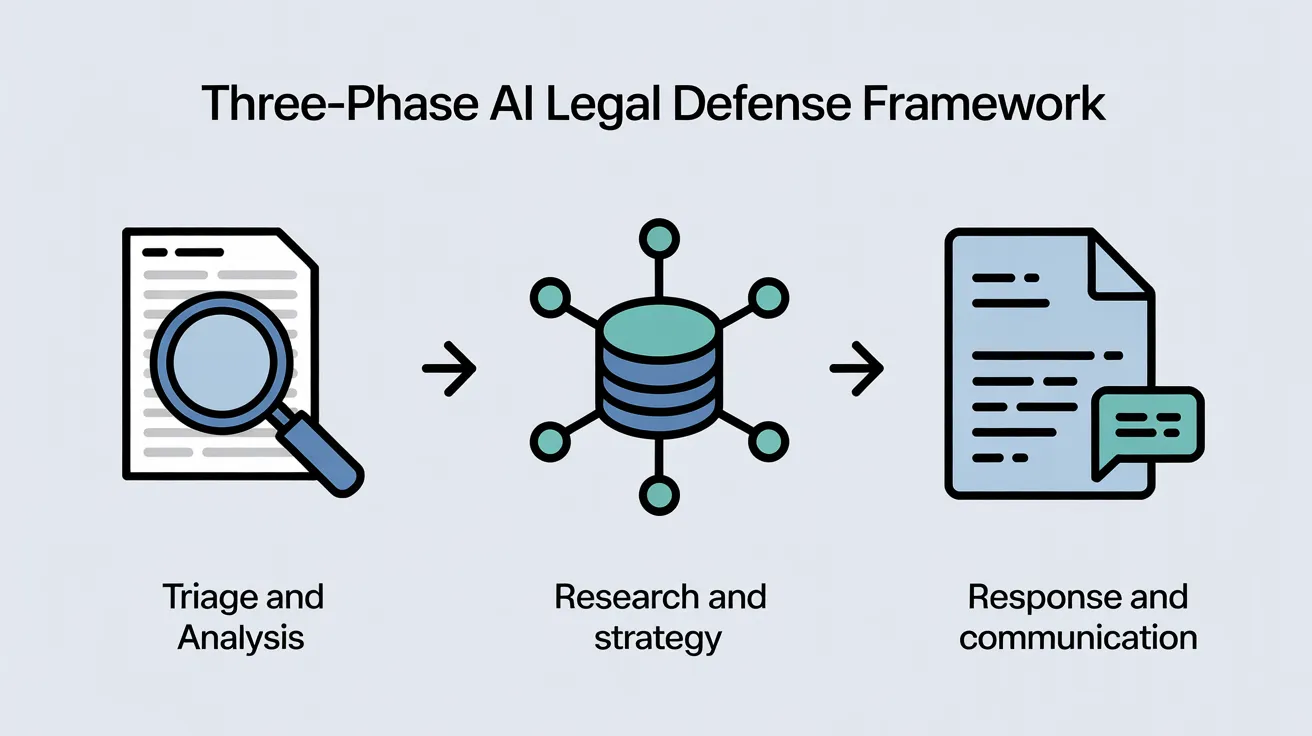
Implementing AI for legal defense is not just blindly trusting a chatbot. It's about following a structured process to evaluate the situation, grasp your stance, and reply from a foundation of strength. This methodology typically encompasses three critical phases.
Phase 1: Assessment and Triage
The first step is to use AI to understand what you're dealing with. You can input the demand letter or legal threat into an AI tool and have it conduct an initial analysis. The aim is to address several critical questions:
- What is the key complaint
- What specific laws or regulations are being referenced?
- Can we verify if the claimant is the actual rights owner?
- What evidence have they presented?
- Are there any concerning indicators within their submission?
This preliminary evaluation allows you to move from feeling overwhelmed to being well-informed and composed. It delivers a clear, unbiased summary of the circumstances.
Phase 2: Research and Strategy
After understanding the claim, the next process is to leverage AI to examine your defensive options. For a copyright claim, you can direct the AI to investigate the four factors of fair use and their significance in your individual situation. For a debt collection notice, you need to direct it to explain the validation requirements under the Fair Debt Collection Practices Act (FDCPA). This stage is dedicated to constructing your case. You are accumulating the legal principles and facts that will create the groundwork of your response. This is also where you can commence to identify the weaknesses in your opponent's position.
Step 3: Response and Engagement
With your research finished, you can utilize AI to assist in drafting your reply. This doesn't mean sending a computer-generated response. The goal is leveraging AI as a writing tool. You provide the essential points and supporting facts, and the AI helps formulate them into a professional and coherent letter. Your letter should normally:
- Acknowledge receiving their message.
- Present your viewpoint precisely and succinctly.
- Cite the applicable legal foundations that back up your argument.
- Ask for additional documentation or confirmation, where necessary.
- Keep the content factual and emotion-free.
This methodical response shows the other side that you are organized, informed, and prepared to defend your position. It promptly shifts the interaction from one of coercion to one of a professional legal discussion.
AI-Powered Copyright Claim Analysis and Response
Copyright claims stand as a major concern for digital enterprises. A company might use an image in their content, only to receive a hefty financial demand from a photo licensing agency months later. Artificial intelligence proves especially useful for such cases.
Assessing the Claim
An automated system can help you analyze the copyright claim. It can analyze the demand letter to check whether it provides proof of copyright ownership, a valid registration number, and a specific account of the alleged infringement. A lot of claim letters from aggressive copyright enforcers are deliberately ambiguous and are missing this vital documentation. As one business owner Tony copyright of LinkDaddy discovered, artificial intelligence can be utilized to evaluate the validity of a claim, enabling the successful defense against a $500,000 copyright lawsuit without engaging a lawyer.
Understanding Fair Use Principles
AI functions as a valuable instrument for exploring the principle of fair use. Fair use stands as a legal principle that enables the limited use of copyrighted material without permission from the copyright owner. Artificial intelligence can assist you understand the four factors of fair use and how they might apply to your case, offering you with the reasoning necessary to build a robust defense.
AI-Powered Debt Collection Defense Strategies
A different sector where AI is having a substantial effect centers on standing up to pushy collection agencies. The FDCPA provides business owners and consumers defined legal protections, like the authority to ask for proof of debt.
The Significance and Value of a Letter of Validation
A debt collection company needs to provide you with information about the debt, known as validation documentation. When you write a debt validation letter, you are legally demanding that the collector prove that you owe the debt and that they have the authority to collect it. A lot of debt collectors, specifically those who purchase old debt, cannot provide this information. Artificial intelligence can help you with creating a comprehensive debt validation letter that requests all the required details, such as:
- The name of the initial creditor
- The initial account number
- A copy of the original signed contract.
- A complete listing of the supposed financial obligation.
Submitting a well-written validation letter typically halts a debt collector from proceeding. When they fail to validate the debt, they cannot legally pursue collection.
Navigating AI Legal Defense: Understanding Its Strengths and Weaknesses
It is crucial to comprehend the limitations of AI in the legal sector. AI acts as a learning and preparation resource, not a licensed attorney. Recognizing the difference between what you can do independently and when you need professional help is essential for a strong defense strategy.
Situations Perfect for AI-Powered Defense
- Initial Threat Assessment: Examining demand letters and cease and desist notices.
- Responding to Baseless Claims: Developing strategies against debt collection agencies and copyright harassers who use intimidation methods.
- Legal Research: Examining your rights and the laws applicable to your case.
- Organizing Your Case: Organizing your documents and key points prior to meeting with a legal professional, which can help you save thousands in legal fees.
When to Get a Lawyer Without Delay
There are particular circumstances when you shouldn't attempt a DIY legal defense. When you receive a formal lawsuit, you should hire a lawyer. Additional circumstances that require professional legal help include:
- Criminal accusations.
- Government agency regulatory investigations.
- Complicated legal cases relating to numerous parties or jurisdictional matters.
- Critical situations where the potential damages could destroy your company.
Under these circumstances, the role of AI transforms from a primary defense mechanism to a support system. You can leverage it to be better informed and prepared as a client, but you require an experienced professional on your side.
Creating Your AI Legal Defense Arsenal
Starting AI legal defense doesn't require a qualification in computer science. It essentially requires a desire to learn and availability of the appropriate tools. The foundation of your toolkit will be a robust language model like ChatGPT or Claude, combined with an educational platform that offers specific prompts and frameworks for standard legal threats.
The Vital Importance of Well-Crafted AI Instructions
The success of any AI solution relies on how well you craft your prompts. A general prompt like "write a response to this demand letter" will result in a generic and likely ineffective response. Conversely, a targeted prompt will guide the AI to perform an in-depth evaluation and create a response grounded in particular legal concepts. This explains why platforms that offer proven prompts and frameworks are so valuable.
Real-World Success Stories: Small Businesses Fighting Back
The inspiring case of Tony copyright, who protected his business over $511,000 by utilizing AI to combat three major legal threats, stands as a powerful example of what is achievable. Yet he isn't alone. Across the country, small business owners are realizing that they possess more power than they initially thought. They are leveraging AI to dispute baseless copyright claims and force debt collectors to validate their debts. These victories are not simply about saving money; they are about reclaiming a sense of control and choosing not to be victims of a system that has historically been weighted against them.
Legal Defense Solutions: What's Next for Small Business Owners
The incorporation of AI in the legal industry is still in its early stages, but the trend is unmistakable. The delivery of legal services is growing more affordable and available. The traditional gatekeepers of the legal profession are being challenged by technology that empowers individuals and small businesses. This isn't to say that lawyers will be replaced. It indicates that their role will transform. They will have the opportunity to dedicate themselves to the high-level, complex work that truly requires their expertise, while AI manages the more standard and preparatory activities.
Small business proprietors, this marks a positive development. This suggests that in the future, a legal issue won't necessarily be a moment of financial panic, but rather a problem to be solved efficiently and thoughtfully.
Beginning Your Journey: Your First Steps with AI Defense Solutions
As a small business owner, you need to begin exploring AI legal defense right now, ahead of potential challenges. Get to know existing resources and solutions. Understand the basic principles of copyright law and debt collection. By taking these proactive steps, you can build a shield around your business. You can evolve from being a vulnerable business into a well-equipped protector of your business achievements.
FAQs
Can AI truly assist with legal defense, or is it just marketing hype?
AI functions as an essential instrument for legal defense, but it's important to understand its role. It doesn't take the place of an attorney. Instead, view it as a highly effective support tool for research and preparation. It assists in analyze documents, grasp complicated legal matters, and prepare preliminary responses, all of which results in saving a significant amount of time and money. The essential approach is to utilize it for preliminary defense preparation and to recognize when to involve a legal professional.
How do I choose between AI tools and legal counsel?
Make use of AI tools when conducting the initial evaluation of legal challenges, when crafting responses to seemingly baseless claims (like those submitted by copyright trolls), and for organizing your documentation. It's crucial to engage a lawyer immediately if you are presented with a lawsuit, are facing criminal charges, or are dealing with a complex legal matter that might affect your business. A reliable guideline is: leverage AI for groundwork, but work with a lawyer for litigation.
How cost-effective is AI for legal defense?
The cost savings can be substantial. The initial legal review and demand letter response can cost thousands in lawyer fees. An AI-based solution can accomplish this at a much lower price. When threats are resolved at this early stage, savings can reach tens of thousands of dollars. Even if legal representation becomes necessary, AI preparation can reduce attorney billable hours.
What are the boundaries of AI in legal situations?
AI systems face several significant constraints. It cannot act as legal counsel due to lack of legal standing. It doesn't possess the sophisticated judgment of a seasoned lawyer and may not grasp the complexities of specific cases. Additionally, it functions based on its training data, which could be outdated. Above all, AI can only offer information and assistance, not legal advice.
Is it legal utilizing AI to conduct legal document analysis?
Using artificial intelligence for document analysis and understanding is perfectly legal. This is merely using technology as a research and preparation tool, comparable to using a search engine or word processor. The key legal limitation is that you cannot claim to be a legal professional without proper credentials, and artificial intelligence cannot function as your legal representative.
6. What indicates if a legal threat is valid versus pure harassment?
Here's where AI analysis becomes particularly useful. An authentic legal claim will usually be specific, provide proof of the allegations (like a copyright registration number), and be sent by a legitimate law firm. A bullying strategy, however, is often ambiguous, doesn't include evidence, and frequently includes aggressive or unprofessional language intended to force a hasty payment. AI helps you identify these warning signs.
How does the Fair Debt Collection Practices Act (FDCPA) safeguard my rights?
The FDCPA serves as federal legislation that limits the actions of third-party debt collectors. It protects you from deceptive, abusive, or unfair practices. One of its most powerful provisions is your right to request validation of the debt. When debt collectors fail to demonstrate the debt's validity and their authority to pursue collection, they are required to cease collection activities. This provides essential protection for business proprietors who could be pursued for old or invalid debts.